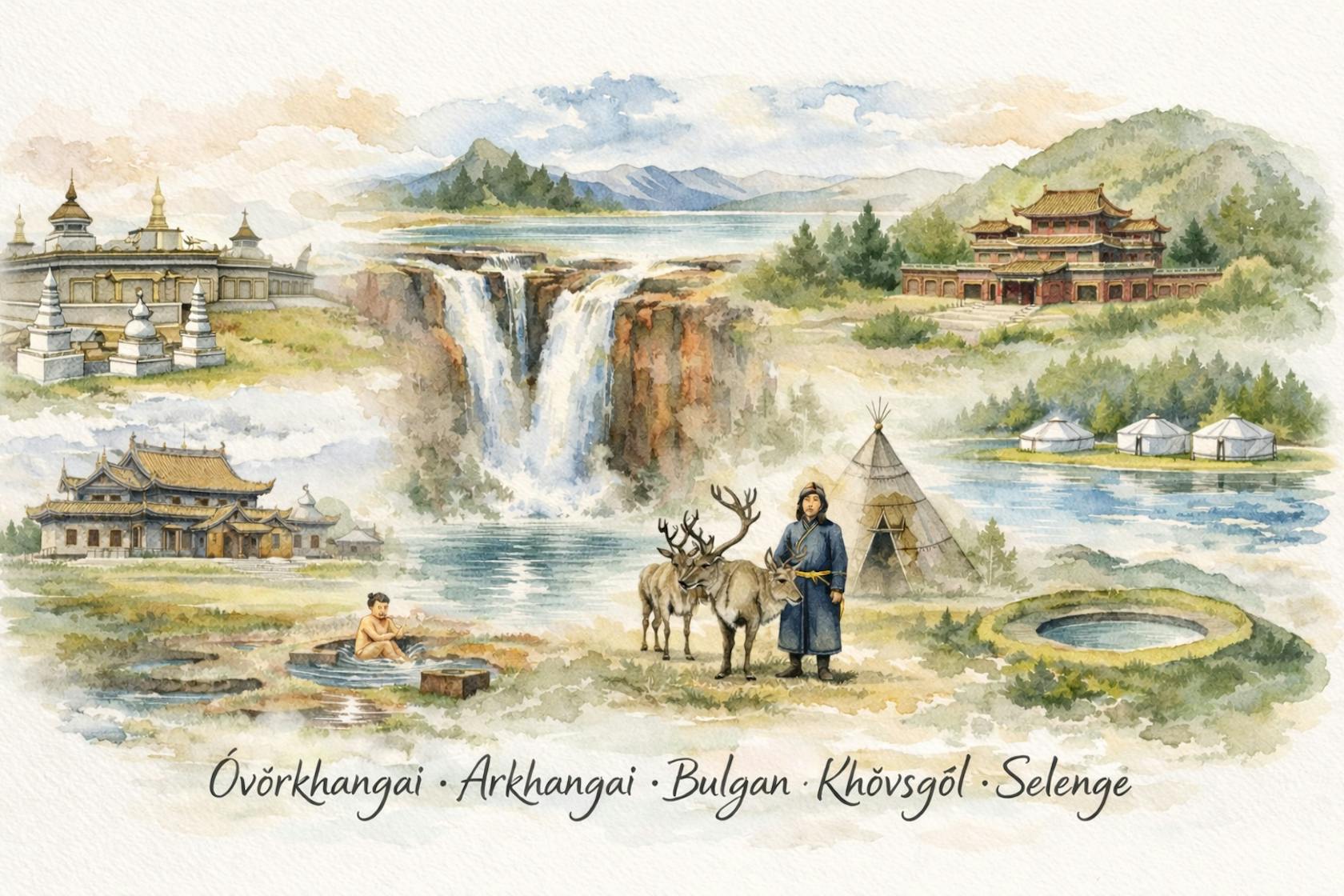
 Note: Image generated using ChatGPT
When traveling through the northern part of Mongolia, you will visit the provinces of Övörkhangai, Arkhangai, Bulgan, and Khövsgöl. Since these provinces are dominated by forest-steppe landscapes, you will be greeted by dense green forests, flower- and berry-covered meadows, and luxuriantly flowing rivers and streams. On this journey, you can see in one complete route Mongolia’s very first city, historically valuable monuments and memorials that have been preserved, uniquely formed mountains and rocks created by volcanic eruptions, and magnificent natural scenery. Because there are so many things to see and experience, the northern part of Mongolia is undoubtedly the first choice for tourists traveling in Mongolia. It is possible to travel through the northern part of Mongolia by car.
Day 1:
Övörkhangai (Uvurkhangai) Province
Elsen Tasarkhai
Depart from Ulaanbaatar city heading northwest toward Övörkhangai province. On the way from Ulaanbaatar to Övörkhangai, you can visit “Elsen Tasarkhai.” This is an approximately 80-kilometer-long sand dune that stretches from the western side of Batkhaan Mountain through the territories of Erdenesant soum of Töv province, Bürd soum of Övörkhangai province, and Gurvanbulag soum of Bulgan province, extending along the western side of Khögnö Khan Mountain. The central road divides the sand dunes into two parts: the southern part is called Mongol Els, and the northern part is called Khögnö Tarnyn Els.
Kharkhorin, Erdene Zuu Monastery
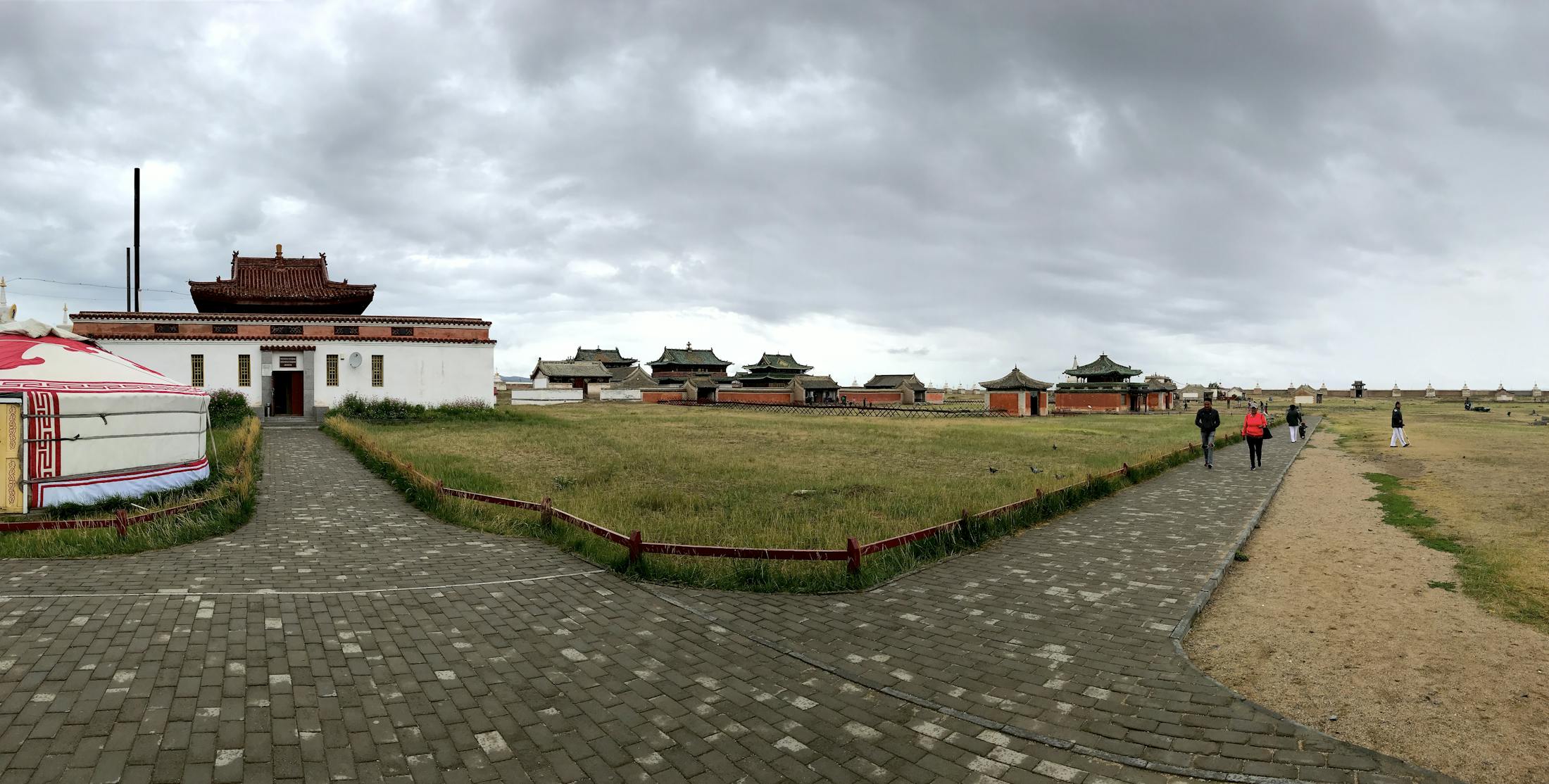
Continuing along the paved road, you will reach Kharkhorin soum of Övörkhangai province, located 359 km from the capital city. By visiting this soum, you will have the opportunity to see the ancient Erdene Zuu Monastery located to the east of the center of Kharkhorin soum. Erdene Zuu Monastery is the oldest Buddhist monastery in Mongolia. It is located next to the ruins of the ancient city of Kharkhorum. This monastery is part of the Orkhon Valley Cultural Landscape, which is registered as a World Heritage site. It has 126 stupas. Today, Erdene Zuu functions both as an active Buddhist monastery and as a museum. After visiting Erdene Zuu Monastery, you can rest at nearby tourist camps and hotels.
Day 2:
Shankh Monastery
Visit the ruins of Shankh Western Monastery, located 4 km from the center of Shankh bagh of Kharkhorin soum. This monastery was originally established in 1650 and was formerly the main monastery of the Tüsheet Gün khoshuu of Tüsheet Khan province.
Khujirt Soum
Khujirt soum is famous for its hot mineral springs with carbonate-sulfate-sodium-calcium composition and fluorine and nitrogen content. These springs are mainly used for joint and skin diseases, bone injuries, women’s health issues, and nervous system disorders. There are sanatoriums in Khujirt soum based on these hot springs. Along with providing medical treatment, they also offer services to relieve fatigue.
Day 3 & 4:
Tövkhön Monastery
Continuing through Khujirt soum, head toward Tövkhön Monastery. Tövkhön Monastery is located 24 km northeast of the center of Bat-Ölzii soum in Övörkhangai province, on a small terrace among rocky formations resembling a seat on the summit of Shiveet Ulaan Mountain.
Üürtiin Tokhoi
Üürtiin Tokhoi is a gorge with cliff walls located 18 km northeast of the center of Bat-Ölzii soum. It stands at an elevation of 1,630 meters above sea level. There is a cold carbonated mineral spring here that is beneficial for internal diseases. It was originally called Khüürtiin Tokhoi, and there are many legends associated with this place.
Ulaan Tsutgalan
Ulaan Tsutgalan Waterfall is located 28 km west of the center of Bat-Ölzii soum in Övörkhangai province. The waterfall drops from a height of 24 meters and is approximately 5–7 meters wide. This waterfall was formed around 20,000 years ago due to earthquakes and volcanic eruptions. Since it is located at the mouth of the Ulaan River, a tributary of the Orkhon River, it was named Ulaan Tsutgalan Waterfall.
Orkhon Valley World Cultural Heritage
The Orkhon Valley Cultural Landscape is located approximately 360 km from Ulaanbaatar, stretching along the banks of the Orkhon River flowing through central Mongolia. UNESCO registered this area on the World Heritage List in 2004 during its 28th session. The Orkhon River Valley contains invaluable monuments that demonstrate how nomadic civilizations in Central Asia evolved over more than two thousand years. The Orkhon River Valley has long been the center of powerful steppe nomadic empires. The earliest evidence of this is the stone monument with Runic inscriptions dedicated to Bilge Khagan of the Göktürk Empire, which existed in the 8th century. Located 25 km north of this monument are the ruins of Ord-Baliq, the capital of the nomads. During the Turkic period, Mount Etügen in the Orkhon River Valley served as a spiritual and political center. During the Khitan rule, numerous stone monuments inscribed in three languages were created, reflecting their power.
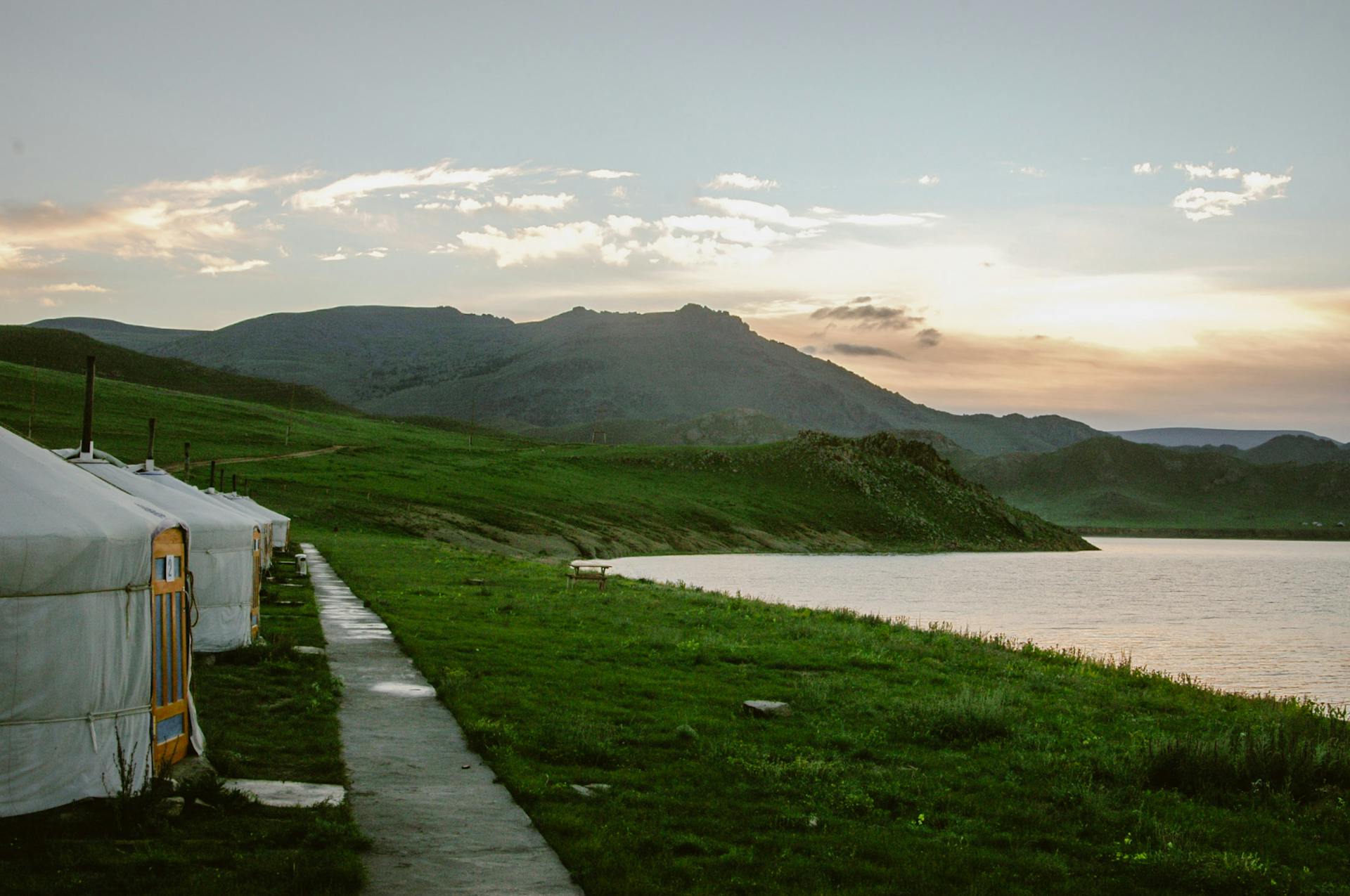
There are many tourist camps located throughout the Orkhon River Valley. You can stay at one of your choosing and relax while enjoying the natural scenery.
Day 5 and 6:
Arkhangai Province
Tsenkher Hot Springs
Travel to Arkhangai province and visit the Tsenkher Hot Springs located in Tsenkher soum. Tsenkher soum is located about 30 km south of Tsetserleg city. It lies at an elevation of 1,860 meters above sea level on the slope of a forested mountain. It ranks second in Mongolia in terms of water temperature and discharges up to 10 liters per second from underground. Scientists believe it was formed during the Quaternary period and emerges at a temperature of 86°C without mixing with surface water.
Day 7:
Taikhar Rock
Taikhar Rock is a coarse-grained granite cliff located on the bank of the Tamir River in Ikh Tamir soum, Arkhangai province. It contains many inscriptions and relics dating from the 7th to the 9th centuries. There are numerous legends and scientific explanations related to this stone monument.
Terkhiin Tsagaan Lake
Terkhiin Tsagaan Lake is a freshwater lake located near Khorgo Crater in Tariat soum, Arkhangai province. The lake is 16 km long, 6 km wide, covers an area of 61 square kilometers, and is a flow-through lake with a depth of 20 meters.
Khorgo Crater
Khorgo Crater is an extinct volcano located in the center of Tariat soum, Arkhangai province, which erupted approximately nine thousand years ago. It is considered the most recently extinct volcano in Mongolia, and it is said to have erupted twice. There are tourist camps near Terkhiin Tsagaan Lake and Khorgo Crater where you can relax and enjoy the natural scenery.
Day 8:
Tsetserleg
Arrive in Tsetserleg city, the center of Arkhangai province, and visit the majestic and beautiful Bulgan Mountain located at the northern edge of the city center. The protected Bulgan Mountain contains many historical relics. One of them is the uniquely formed stone depiction of the map of Mongolia on its slope and foothills. Climbing Bulgan Mountain once involves walking 744 steps and burns approximately 130 kcal. On the mountain slope, a portrait of Bogd Tsongkhapa created in the 18th–19th centuries remains clearly visible, along with many inscriptions carved into stone in Uyghur-Mongolian and Tibetan scripts. While visiting Tsetserleg city, stop by Fairfield Guesthouse Café Bakery & Travel to enjoy brewed coffee, delicious homemade bread, pizza, and burgers. The beautiful natural scenery combined with the taste of coffee is sure to provide a pleasant experience.
Day 9:
Bulgan Province
Khögnö Tarna Natural Complex
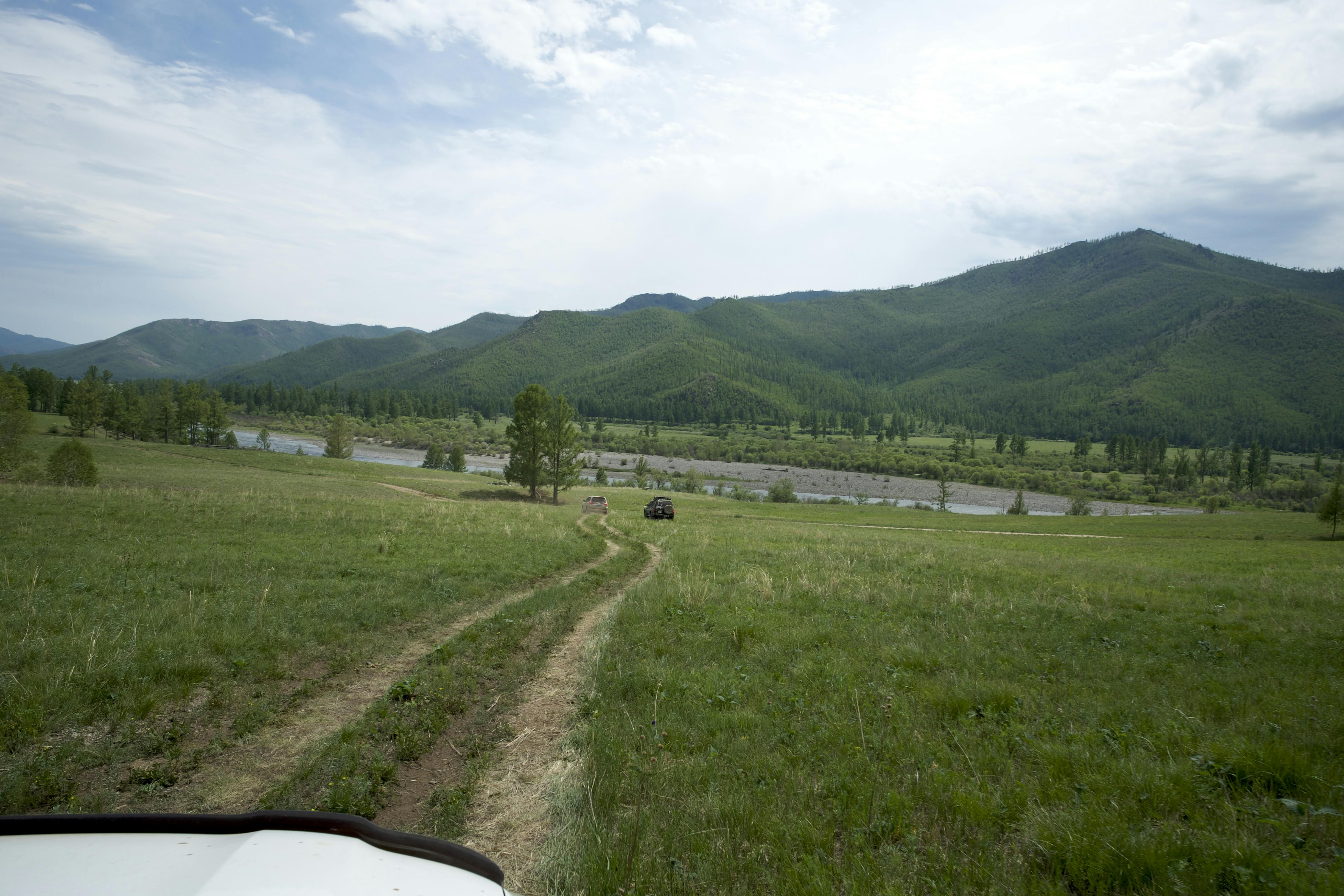
After exploring the beautiful sites of Arkhangai, head to Bulgan province and first visit the Khögnö Tarna Natural Complex. Khögnö Tarna is a natural complex area that spans the territories of Gurvanbulag and Rashaan soums of Bulgan province and Bürd soum of Övörkhangai province. Khögnö Khan Mountain is one of the four sacred mountains that were worshipped for religious and political significance during the Bogd Khanate of Mongolia. The largest river in the complex is the Tarnyn River, which flows into the Tuul River and belongs to the Orkhon–Tuul river basin. This is a naturally beautiful area that includes mountains, rivers, and sand dunes. There are comfortable tourist camps located near the complex.
Khar Bukhiin Ruins
Located 12 km west of the center of Dashinchilen soum in Bulgan province, on the southern bank of the Khar Bukhiin River and northeast of Khadaasan Tolgoi, are the ruins of an ancient city. These are known as the Khar Bukhiin or Khadaasangiin ruins.
Uran Togoo Mountain
Uran Togoo is an extinct volcano located in Khutag-Öndör soum of Bulgan province. It rises to 1,686 meters above sea level and has a crater 500–600 meters wide and 50–60 meters deep at its summit. Inside the crater is a lake approximately 20 meters in diameter and 1.5 meters deep, surrounded by forest. You will stay overnight at a nearby tourist camp.
Day 10 & 11:
Khövsgöl (Khuvsgul) Province
Khövsgöl Lake
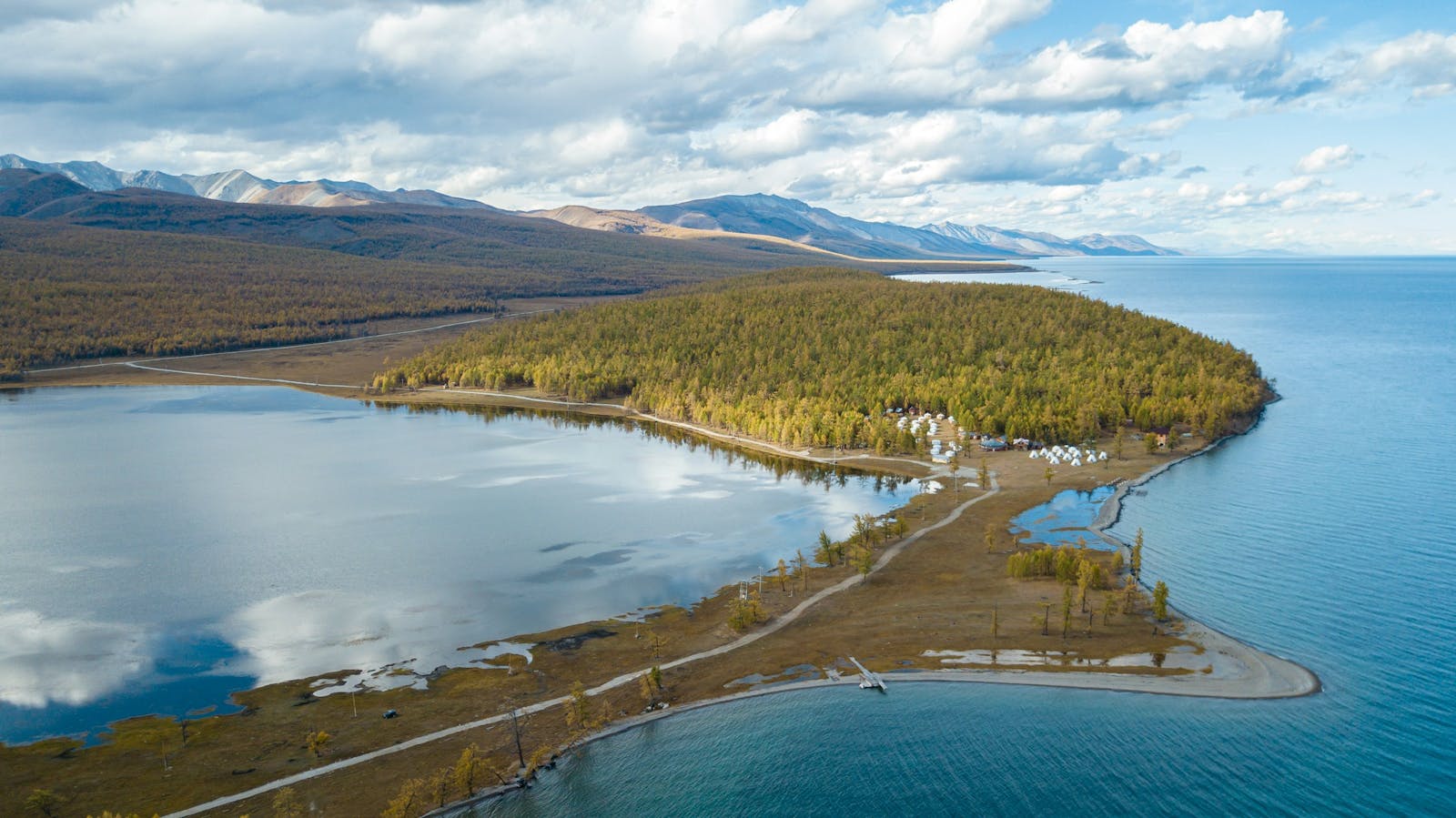
Continue your journey at the beautiful Khövsgöl Lake. Mongolians sometimes call Khövsgöl Lake “Mother Ocean.” Khövsgöl Lake is the deepest, freshest, and largest-volume lake in Mongolia, stretching 136 km in length and 35 km in width. It has three islands: Modon Khui, Khadan Khui, and Dalain Khui, the largest being Dalain Khui Island. There are port villages with waterway terminals at Khatgal in the south and Khankh in the north, and water transport operates during the summer.
Day 12:
Reindeer Herders’ Land
Visit to the Khövsgöl province is incomplete without meeting the reindeer herders. Their fascinating way of life and culture will undoubtedly capture your interest. Briefly introduced, reindeer herders are Tuva people who migrate year-round in the taiga while herding reindeer. The reindeer herders live in the soums of Ulaan-Uul, Renchinlkhümbe, Bayanzürkh, and Khankh in Khövsgöl province. You can learn about their lifestyle and culture and stay overnight in the shelters where they live.
Day 13:
Selenge Province
Saikhanii Khötöl (Saikhnii Hutul)
Saikhanii Khötöl is a natural complex area located about 10 km from Sükhbaatar city in Selenge province, near the Mongolian–Russian border. Today, it is a must-visit destination for tourists and travelers visiting Selenge province. Travelers go there before dawn to admire the beautiful natural scenery and watch the sunrise. One of the scenic highlights of Saikhanii Khötöl is the confluence of the Orkhon and Selenge rivers. These major rivers of Mongolia merge at this location and then flow onward into Lake Baikal. There is also a cave at Saikhanii Khötöl associated with a legend that brave men once gathered there. Today, stone benches and tables have been arranged, and three hearth stones have been placed at the site. After visiting Saikhanii Khötöl, you can stay overnight at a hotel in the provincial center.
Day 14:
Amarbayasgalant Monastery
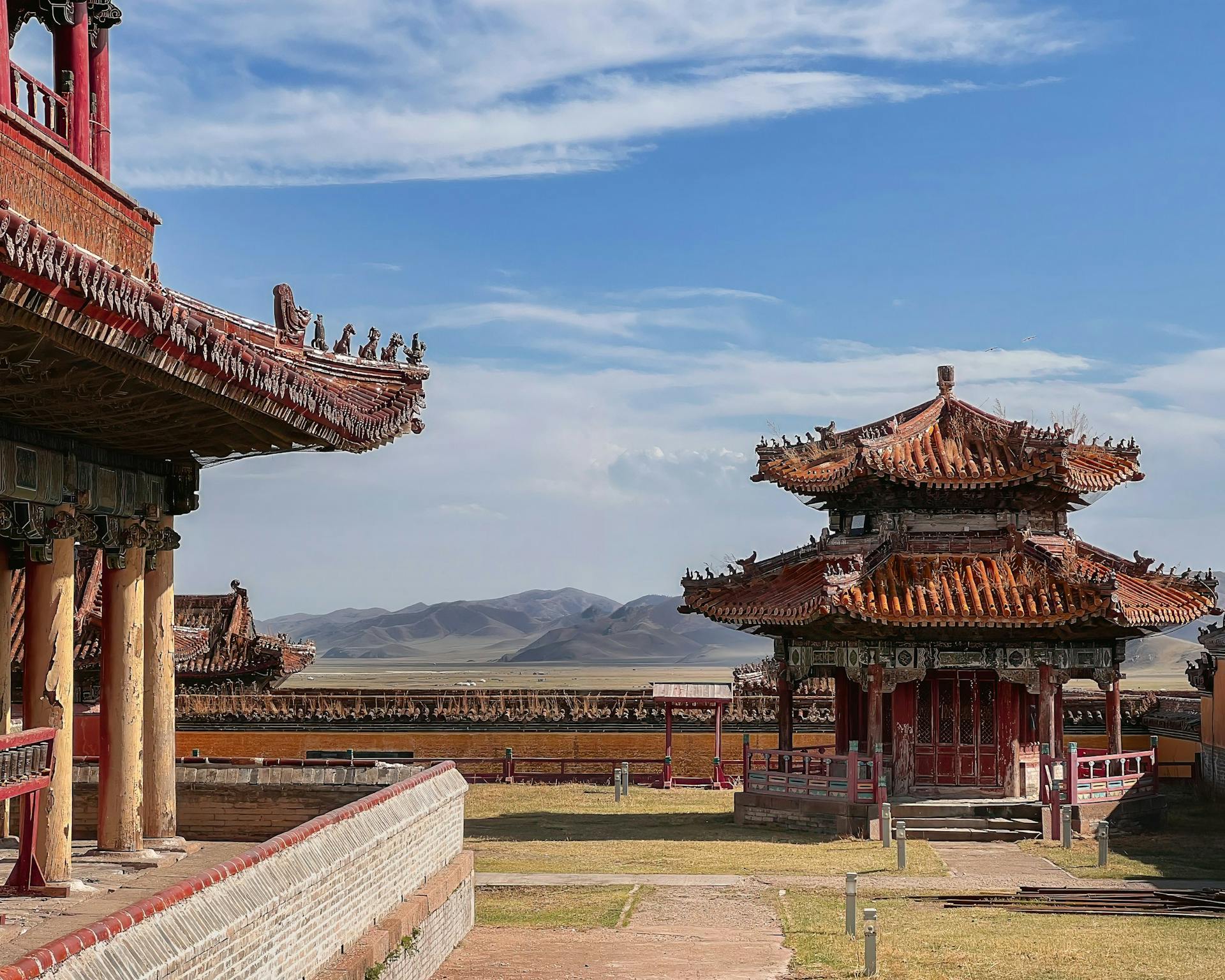
Amarbayasgalant Monastery is located at the source of the Iven River on the southern slope of Burenkhaan Mountain in Selenge province. In 1725, the Qing Emperor Kangxi issued a decree to build a monastery dedicated to honoring the deeds, wisdom, talent, and artistic genius of Mongolia’s first Bogd, G. Zanabazar, allocating 100,000 taels of silver from the state treasury. In 1726, many Mongolian master craftsmen began construction using bricks and wood, and the monastery was completed in 1737.
Thus, the journey through the northern part of Mongolia concludes, returning from Selenge province to the capital city.
How do I book this tour?
Tour Packages
If you are looking for short tour & holiday itineraries then you can contact us. We will find you reliable and safe tour operator for all budget types.
Travel Independently
- Hire a car with or without a driver for the ultimate freedom and comfort. We highly recommend MyCar.rent and Avis Mongolia for the international standard of service.