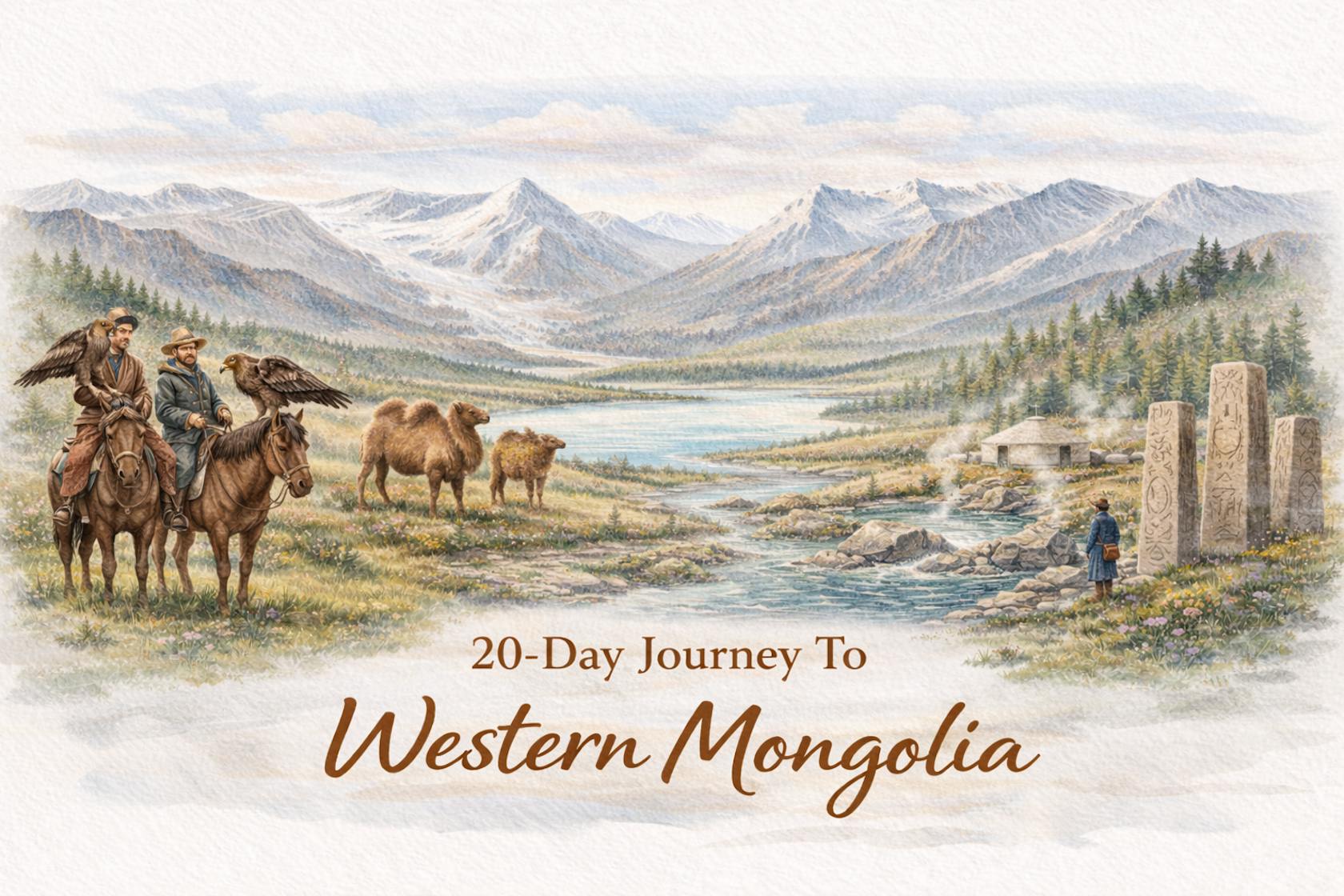
Embarking on a journey through western Mongolia means discovering the untamed beauty and cultural heritage of Bayankhongor, Govi-Altai, Khovd, Bayan-Ulgii, Uvs, and Zavkhan provinces.
DAY 1:
Bayankhongor
On the first day, depart from Ulaanbaatar city, pass through Arvaikheer city of Uvurkhangai province, get acquainted with the Mongol horse statue complex, and head to Bayankhongor province. On the first day, in the center of Shargaljuut of Bayankhongor province, stay at a hotel.
DAY 2 & 3:
Shargaljuut mineral spring
On the second day, depart to Erdenetsogt soum located 60 km to the northeast from the center of Bayankhongor province. In this soum there is Shargaljuut mineral spring. Shargaljuut is Mongolia’s largest mineral spring deposit with more than 300 springs with a temperature of 40–96 degrees, flowing covering an area of 10 ha. In history it is recorded that in the VII century the Kyrgyz used Shargaljuut mineral spring to heal their sickness. Subsequently, in the 1690s, Mongolia’s nobles began to pay attention to using it as a method to treat and nurse the people, conducting research at the spring. Later, a person called Rihe Azala of India did retreat for three years at this spring and defined that there are 108 types of springs that heal 64 basic diseases. After this, Russian and Mongolian scientists continuously conducted research and from 1960 established a state-service sanatorium and have been carrying out its activities up to today.
Tamchi canyon
At a distance of 62 km from Erdenetsogt soum, there is a very majestic deep canyon formed from an ancient great fracture, where mountain-river water cut through volcanic basalt stone. Because the height of this canyon reaches 380 meters, in the winter season the sun does not shine on the bottom. Also, there is no other way than to pass with an ordinary vehicle by only two routes called Givën and Khaliut. After seeing and becoming interested in this canyon, return and stay overnight at the Shargaljuut resort and sanatorium.
DAY 4:
Departing from Shargaljuut, arrive in Bayankhongor province, eat lunch, then move onward to Tsogt soum of Govi-Altai province. Arrive at the soum center and stay overnight, and in the morning see and become interested in the natural monument place of the beautiful Eej khairkhan mountain.
DAY 5:
Natural monument place of Eej khairkhan mountain
Eej Khairkhan mountain is one of the naturally beautiful places with a unique formation located in the southwestern border of our country, and it is in the territory of Tsogt soum of Govi-Altai province. Among the beautiful mountain ranges at the border of the Altai southern Gobi, by its own unique appearance, “Eej Khairkhan mountain” clearly stands out. In addition to being a natural monument, Eej Khairkhan mountain, which became a historical monument, was taken under special protection in 1992 and in 1995 was taken under state special protection as a natural monument place. In Eej Khairkhan mountain there are many rare and interesting sights of unique natural formation that attract foreign and domestic travelers. For example, it has nine kettle hollows formed along a rock vein, and at the beginning of the nine kettles there is a small oasis. Local elders tell as a legend that this oasis is the summer camp of a hermit lama. Besides these, there are rocks with interesting formations such as Yembuu, Turtle, Mother’s womb rock, Dove, Maiden tongue, Theater seat, Officials’ seat, and Boov. It is believed that a person who bowed and prayed at Yembuu rock will go abundant and plentiful in wealth for nine generations, and that a person who passes through the Mother’s womb rock will become as if reborn. There are many examples that a family that could not have children came and believed at Dove rock and had children.
Bayantooroi oasis
Bayantooroi is a village located in the territory of Tsogt soum of Govi-Altai province. This village, which engages in irrigated agriculture relying on the Gobi oasis, is located 62 km to the south from the center of Tsogt soum. The protection administration of Section A of the Great Gobi Strictly Protected Area is in Bayantooroi. After seeing and becoming interested in the oasis, stay overnight in Tsogt soum. In the morning, move to Biger soum and join the main road. Also, in this soum, a chance to see the world’s very rare Mazaalai may occur. Departing from Tsogt soum, head to Sharga soum.
DAY 6:
Steppe waterfall
Sharga soum of Govi-Altai province is 89 km to the west from the provincial center, and is the steppe land at the southernmost edge of the Great Lakes Depression. The river flowing in this steppe land flows as a waterfall through a cliff of more than 20 meters height, creating natural beauty. Steppe waterfall is necessarily included in the route of travelers heading to Govi-Altai province. While seeing this waterfall, stay overnight in Sharga soum.
DAY 7 & 8:
Sutai khairkhan
Departing from Sharga soum, join the main road and move to the territory of Khovd province. This road passes through Darvi soum of Khovd province. From this soum, it is possible to see the famous Sutai khairkhan. Sutai khairkhan is the southernmost of the Altai’s eternally snow-capped mountains, and it is explained as a Turkic-origin word meaning “Watered mountain” (Su+tau). It is a state-worshipped khairkhan located at the boundary of Darvi and Tonkhil of Govi-Altai and Darvi and Tsetseg soums of Khovd province. In an ancient legend it is told that it broke off from the snowy Himalayan mountains and, as one part of the Altai range, formed by solidifying and growing as an umbilicus ice on the eastern part of Baatar khairkhan mountain. Eat in Darvi soum and head to Mankhan soum of Khovd province.
Gurvan Senkher cave
About 30 km to the west from the center of Mankhan soum of Khovd province, Gurvan Senkher cave is located. In this cave there are historical relics such as traces of ancient people living 40,000 years ago and rock paintings. From the fact that on the cave wall there are rock paintings of wild goats with backward-curving horns, deer, bull, snake, bird, ostrich, elephant, camel, ibex and such animals, it shows that in ancient times the above animals lived in Mongolian territory and the climate condition was humid and hot like the present African continent. Stay overnight at the recreation place beside Gurvan Senkher cave.
DAY 9:
Khar us lake
On the road from Mankhan soum of Khovd province going to Khovd city, there is Khar us lake. This lake is a freshwater lake with an area of 1153 square kilometers, 72 kilometers long, 26 kilometers wide, with reeds and rushes along its southern edge. Of more than 10 big and small islands in Khar us lake, the largest is an island called “Agshab,” about 30 kilometers long and 272 meters high above the water surface. After seeing and becoming interested in this lake, head to Khovd city, the center of Khovd province. Stay overnight at a hotel in the provincial center.
DAY 10:
Tolbo lake
Departing from the center of Khovd province, get acquainted with Tsambagarav mountain, one of the eternally snow-capped lord peaks, and head to Tolbo lake in the territory of Tolbo soum of Bayan-Ulgii province. Tolbo soum of Bayan-Ulgii province is located 75 km from the provincial center. Tolbo lake is located 5 km from the center of Tolbo soum. This lake is a major freshwater lake of the Mongol Altai range. It is surrounded by bare mountain ranges with high rocks and cliffs around it. In Tolbo lake there are several small islands, and the largest is Gichgenii tolgoi. This lake gathers to itself about ten rivers and streams that flowed through mountain valleys and gorges to form its water, and passes its excess water through the Turgen river to give to the Khovd river, but in dry drought times it becomes without outflow. Even so, it has very fresh water. Many kinds of birds such as the water-hooded eagle, saker falcon, whooper swan, duck, coot, and cormorant or black goose come and summer at Tolbo lake. Also, fish such as Altai osman and Mongolian grayling are abundant in the lake. Stay overnight at the recreation place on the shore of this lake.
DAY 11:
Arrive in Ulgii city, the center of Bayan-Ulgii province. Stay overnight at a hotel located next to the central square of the provincial center, and rest preparing for tomorrow’s long travel.
DAY 12 & 13:
Altai Tavan Bogd
In the morning, depart toward Altai Tavan Bogd.
Altai Tavan Bogd mountain of the Mongol Altai range is located in Ulaankhus soum of Bayan-Ulgii province. Tavan Bogd mountain is Mongolia’s highest mountains. In this sense, it is called the roof of Mongolia. Tavan Bogd mountain has five main peaks, and Mongolia’s three largest glaciers—Potanin glacier, Alexander glacier, and Grane glacier—are located in Tavan Bogd. Of these, the largest is Potanin glacier and is about 14 km long. Khuiten peak is the lord peak of Altai Tavan Bogd mountain. Nairamdal peak is the meeting point of the borders of Mongolia, the Russian Federation, and the People’s Republic of China, the tripoint.
In 1996, including Altai Tavan Bogd mountain and the basins of the Khoton, Khurgan, Dayan lakes, and rivers such as Khovd, Khar salaa, Tsagaan salaa, Songinot, Yol, it was taken under state protection as the Altai Tavan Bogd natural complex area. The Altai Tavan Bogd natural complex area borders the Russian Federation on the north side, and on the west side borders the People’s Republic of China from west-southwest of Tavan Bogd up to Ovchuu mountain, and covers a territory 186 km in length and 42 km in width. It has a sharply continental climate. Since Mongolian climbers first climbed Altai Tavan Bogd in 1956, more than 700 climbers have climbed. Even in this time, it has become a mountain that foreign and domestic climbers like to climb.
Going by car, arrive and stay at a Kazakh family in its region at the administration of the protected area of Altai Tavan Bogd, eat dinner, and stay overnight. In the morning, go up to Altai Tavan Bogd.
Baga Turgen waterfall
One of the beautiful places of the Altai Tavan Bogd natural complex area is the Great and Small Turgen Waterfall located in the Baga Turgen gorge of the valley of Khoton and Khurgan lakes of Tsengel soum. This waterfall is distinctive by being located in pristine wild nature that begins from eternally snow-capped mountains and flows, forming a natural beautiful wonder. The height of the waterfall is 15 meters, and this is considered the highest of the waterfalls located in this province. It is rich with larch trees, caragana, and shrub plants in the surrounding mountains. After seeing and becoming interested in this waterfall, stay overnight at a ger lodging prepared for tourists in the beauty of nature.
DAY 14:
Wake up in the morning and head to Ulgii city. Arrive in Ulgii city and eat lunch. Also, you can go up to Nairamdal hill of Ulgii city and see this city from the height. Depart from there and arrive at Achit lake and get acquainted with the beautiful nature around it. Continue moving and see and become interested in Uureg lake, and arrive in Ulaangom city of Uvs province and stay overnight. In the morning, head to Chandman burial and Uvs lake.
DAY 15 & 16:
Uvs lake
It is Mongolia’s largest lake located in the northeast part of Uvs province, at the northern edge of the Great Lakes Depression. The northern end of the lake is located in the Tuva Republic of the Russian Federation. It is said to be a remnant of a huge salt sea that existed many thousands of years ago. Into Uvs lake flow 38 big and small rivers such as Tes, Nariin, Turgen, Kharkhiraa, Khundlun, Sagil, Borshoo, Khandgait, Torkhilog. Around the shore of this lake, people of soums such as Tes, Zuungovi, Malchin, Naranbulag, Tariалан, Ulaangom, Turgen, Sagil, Davst live nomadically. Rest and stay overnight on the shore of Uvs lake, and the next day on the way see and become interested in Chandman burial and head to Khyargas lake.
Chandman burial
It is a burial memorial place located at Chandman mountain about 1 km to the southwest from Ulaangom city, the center of Uvs province. It was first discovered accidentally during construction earthworks, and between 1972–1974, the Mongolian–Soviet joint historical-cultural memorial research team excavated and studied more than 40 graves. In Mongolian archaeological research, it has become customary to name this burial place as Chandman burial. But Russian researchers have written and named this memorial as “Ulaangom burial.” Based on comparative research of the form and workmanship of the bronze finds discovered from Chandman burial, it is related to the VII–IV centuries BC.
Khyargas lake
Khyargas lake is a mineral lake located in Uvs province, in the Great Lakes Depression. This lake was registered as a natural complex area in 2000. Besides Khyargas lake, Airag lake is said to be included in this protection.
Khetsuu rock
On the western shore of Khyargas lake of Uvs province, there is a place named Khetsuu rock with a unique, unusual formation. This natural complex is a community of plants and animals with rocky cliffs and high rock walls over a relatively short distance of 5–7 km. Khyargas lake, where this rock is located, is clear like water crystal, and the fish and fry swimming inside are clearly visible to the eye. There is much to see and be interested in, such as sharp rocks in the middle of the lake and winged birds that made nests on them. There are very rare black goose, gull, and also Altai osman, Mongolian grayling, osman, shar fish and such. “Khetsuu rock” is a place under state special protection, with pristine natural beauty formed, not repeated anywhere. Stay overnight at the recreation place located on the shore of Khyargas lake and continue the travel onward.
DAY 17:
Ulaagchnii Khar lake
It is located 80 km to the northeast from the center of Erdenekhairkhan soum, 110 km from the provincial center. This lake is surrounded on the north side by sand dunes and sand hollows, and on the south side is surrounded by Jaakhan lake with reedbeds in the coastal hollows, and the majestic mountain of Tovkhosh. The depth of the lake is 48 m, it stretches about 30 km in length, and 5–10 km in width. In this lake, two types of fish called Omul and Feld breed, and in the middle of the lake there are two islands named Ikh and Baga Avgash raised 2600 m above sea level. Here, 13 types of migratory birds come. Also, over the lake a flower called shunh has grown and appeared, which looks beautiful. This naturally beautiful lake combining Gobi and Khangai is one of the main tourism regions of Zavkhan province. Arrive at this lake and stay overnight and then move onward.
DAY 18 & 19:
Mukhart river
In the morning, see Mukhart river. Mukhart river begins and flows from a sand dune 450 m above sea level in front of Bor khyar sand to the northeast direction from the center of Erdenekhairkhan soum. Along its shore it has willow thickets, and it is a natural complex area with a unique formation with fruits and berries such as thyme, sea buckthorn, currant, and rose hip. When going to this river, it is suitable to go by a vehicle that will not get stuck when traveling in mud swamp. Today, the number of tourists heading to this river continues to increase every year. After seeing and becoming interested in this place, depart to Uliastai city. Arrive in Uliastai city and stay overnight, and the next morning head to Otgontenger khairkhan.
Otgontenger khairkhan
Mongols have worshipped Otgontenger khairkhan from ancient times, and originally the Turks worshipped it in the VI–VIII centuries. After that, in 1779 it was re-worshipped and then forgotten, and in 1911 the Bogd Khan worshipped it every year according to Buddhist ritual and it was again forgotten. But in 1995 it became state-worshipped and a tradition was established to worship once every four years. This khairkhan is the lord peak of the Khangai range raised 4021 m above sea level. Around it, dense forests, swift-flowing rivers, lakes are abundant, nearby mountains are places with unique natural formations, and the biosphere and ecosystem composition of wildlife is very well formed. Rare plants and animals are abundant, famous mineral spring sanatoriums are on the western shore of Bogd river that begins and flows from the north side. It is located at the boundary territory of Otgon, Tsagaan khairkhan, and Aldarkhaan soums of Zavkhan province, and from the provincial center to Otgon resort is 78 km, and from Otgon soum to Badarkhunda lake at the southern side of the Khairkhan is 65 km. Otgontenger khairkhan was worshipped last year and more than 20 thousand people participated.
Dayan khairkhan
To the west of Otgontenger, there are two majestic khairkhans like sentries, called Ikh Dayan and Baga Dayan, with a height of 2500 meters above sea level. On the two sides of Dayan there are two lakes called Khukh and Tsagaan, and on this mountain there are other rare medicinal plants such as vansemberee, sheep juniper, golden root, jamyanmyadag, which are rare plants of the Otgontenger region. On its top it has a somewhat flat place and in the middle there is taikhar stone. From the mountain top, the nearby high khairkhan mountains such as the Altai blue mountain and Mongol sand seen far away look beautiful like placed on the palm. Continuing, head to Shiluustei soum of Zavkhan province.
Daagan deli’s deer stone monument
In the territory of Shiluustei soum of Zavkhan province, on the wide terrace of the northern slope of Daagan deli mountain, there are two rows of eight deer stone monuments. These monuments are located along the main road going from Zavkhan province to Bayankhongor and are clearly visible from afar. Researchers call this the Daagan deli deer stones. Two of these eight stones have fallen to the ground. On the monuments it is observed that the pinkish granite stone is well dressed and the deer image is depicted elegantly. Also, on the lower body or belt of the stone monuments, depictions such as bow and arrow, dagger knife, shield, axe, and the like are clearly observed. The overall preserved condition remaining of the stone monuments is quite good, and the images and depictions are clearly well visible. Arrive in Shiluustei soum and stay overnight and depart to Uliastai city.
DAY 20:
Arrive in Uliastai city and stay overnight, and the next day fly to Ulaanbaatar city.
How do I book this tour?
Tour Packages
If you are looking for short tour & holiday itineraries then you can contact us. We will find you reliable and safe tour operator for all budget types.
Travel Independently
- Hire a car with or without a driver for the ultimate freedom and comfort. We highly recommend MyCar.rent and Avis Mongolia for the international standard of service.