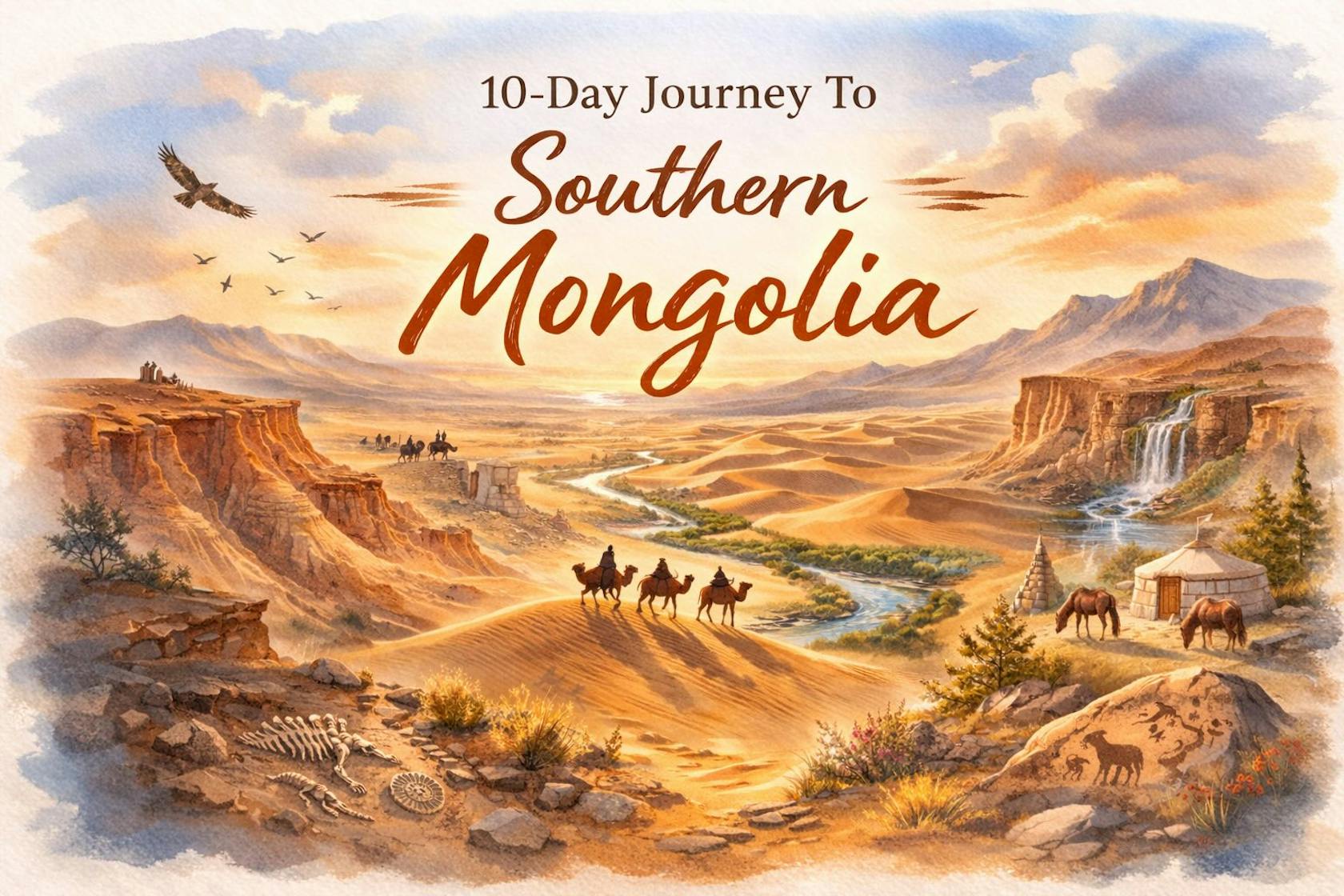
 Note: Image generated using ChatGPT
In the southern part of Mongolia are included the Govi-Sumber, Dornogovi, Dundgovi, and Umnugovi Gobi provinces. Due to the high majestic Himalayan mountain range blocking the rain clouds coming to this region, precipitation is low and thus the Gobi was formed. The Gobi is diverse in terms of nature, climate, and topography, and has many rare animals and plants. Especially Mount Nemegt, located in the territory of Umnugovi province, is famous for yielding many rare fossils of ancient dinosaurs. By traveling through the southern part of Mongolia, in addition to seeing and exploring unique and interesting formations formed in ancient geological eras, you will feel as if you have arrived on the planet Mars. Because it is said that the visible environment, infertile red soil, and air density of the planet “Mars” are very similar to the Mongolian Gobi. For example, the average annual temperature of the planet Mars is -63 degrees cold. Meanwhile, the Mongolian Gobi is the coldest among the seven deserts on earth, reaching -42 degrees cold. Therefore, researchers consider that it is scientifically fully possible to establish a landing team training base for the planet Mars in the Mongolian Gobi and make it the main region of training exercises. In addition to traveling by car to the southern region of Mongolia, it is also possible to fly.
DAY 1:
Umnugovi province
Yol valley
Fly from Khushigt valley airport of Ulaanbaatar city and land in Dalanzadgad city of Umnugovi province. Arrive in Dalanzadgad city and visit the provincial culture-and-recreation, dinosaur park. Continuing, head to the natural complex place called Yol valley of Zuunsaikhan mountain that is in the territory of Dalanzadgad soum. Yol valley is a naturally beautiful territory included in the tourism zone of the Gobi Gurvan Saikhan natural complex place, located at Zuunsaikhan mountain 56 km to the west from the center of Umnugovi province. Here, in addition to there being many lammergeier birds, there are rare animals such as ibex, argali, and lammergeier birds. You can stay overnight at the recreation bases near this natural complex. Or you can rest at a hotel in Dalanzadgad city.
DAY 2:
Bayanzag
Bayanzag is a place with clayey sediments located in a wide valley belonging to the mountainous zone of the Gobi along the Arts bogd mountains to the east from Bulgan soum of Umnugovi province. It has become famous worldwide as a place where rare paleontological finds were found. Also, in addition to dinosaur eggs being found in large numbers, the dinosaur nest was found for the first time in the world exactly from here. In addition to this, velociraptor and the remains of many dozens of mammals were found. Stay overnight at a nearby recreation base.
DAY 3:
Khongor sand
Khongor sand is located in the territory of Sevrei and Bayandalai soums of Umnugovi province. It is a sand dune that continues for about 180 km behind the Sevrei and Zoelen ridge. It continues from northwest to southeast and has a total area of 965 sq km. The widest of the sand is 27 km on its northwest side, and the narrowest is 800 meters in its central part. When you go up to the top of the sand, further on, several hundred dunes and hills continue to be seen. When looking at the surroundings of Khongor sand as a whole, in front there is a rocky mountain, in the middle sand dunes where plants cannot grow, and on the northern slope a river flows and a greened oasis is seen, which is very beautiful. Flood water that came down from the Zoelen ridge makes a path through the middle of Khongor sand and flows through, soaks into the soil, and at the northern edge of the sand, forming streams called Seruun bulag and Arganga bulag, comes out again onto the surface and flows more than 10 km to the west along the edge of its sand, and this is called the Khongor river. When traveling on the sand dune, starting on the nearest hill, you will go up while going diagonally, and if you go from one top to another following the ridge of the hill, it will be convenient. When the sand dunes collapse and slide due to the effect of the wind, a humming sound like an airplane is heard from far away. Because it makes sound like this, local people call it “Singing dune,” it is said. Because tourist camps are located near Khongor sand, you can rest comfortably.
DAY 4 & 5:
Naran daats
Naran daats is a territory composed of Upper Cretaceous sediments with rare paleontological finds, also with a very beautiful oasis with elm, poplar, and saxaul, located 96 km to the northwest from the soum center, in the territory of Gurvan tes soum. From this territory, dinosaur bones such as Therizinosaurus, zabroloj, tarbazabr, horned dinosaur, pinakosaur, and the like were found. Therefore, for many years it is a base place where foreign and domestic dinosaur researchers, exploration-research teams, and tourists stay. In the ravines and gullies around Naran daats, remains of various kinds of dinosaurs, ancient animals and plants remain to this day and continue to be studied. In this place, tourist bases operate by establishing field camps.
Nemegt canyon
Continuing, move to see Nemegt canyon, one of the nine wonders of this province, located 60 km to the north from Gurvantes soum of Umnugovi province. Places such as Nemegt mountain, Altan mountain, Tugrugiin shiree, Ukhaa hill, and Khermen tsav are not only places recognized in the world paleontology field by dinosaur finds, but also international research teams constantly conduct research. In 1946, the Russian–Mongolian joint research team led by the famous Russian writer, scientist, and researcher I.A. Efremov came and found the first, the largest, four-legged, herbivorous 30-meter dinosaur and, including the name of Nemegt mountain, named it Nemegtosaurus (Nemegtosaurus). Nemegtosaurus is a kind of herbivorous sauropod that lived 250 million years ago in the Middle Mesozoic era, it is said.
Khermen tsav
Khermen tsav is a gorge that continues for more than 10 kilometers located to the northwest from Gurvantes soum at the western edge of Umnugovi. In its lower part it is 10 kilometers wide, and in some places it is 100–200 meters deep. Seen from afar it looks like the ruins of a great city. It is Mongolia’s largest canyon, which is rightfully included among the 9 wonders of Umnugovi province and Mongolia. It is a beautiful territory with an oasis with elm, poplar, and saxaul in its near surroundings. The area of Khermen tsav is 250 square kilometers, and the fact that fossils of ancient dinosaurs, mammals, insects, birds, turtles, crocodiles, lake and water animals, and many kinds of plants were discovered from here has confirmed that the Mongolian Gobi is the territory with the most dinosaur finds in the world, and that they are found intact, and is a very important territory in world science. While being interested in these beautiful places of the southern Gobi, stay in Gurvan tes soum, and in the morning set off to Ulziit soum of Dundgovi province.
DAY 6:
Dundgovi province
Tsagaan suvarga
A unique, beautiful nature that attracts the hearts of not only foreign but also domestic travelers that exists in Dundgovi is Tsagaan suvarga. This khairkhan, so beautiful as to amaze not only the Gobi land but Mongolia to the world, is one of the Nine Wonders of Dundgovi province. This is a clay-wall canyon of the great Gobi’s beauty, the shore of the great sea of ancient geological times, the great Gobi’s beautiful perfect stupa canyon. Tsagaan suvarga is located in the territory of Ulziit soum, 156 km to the south from the provincial center. If any mountain, khairkhan, stupa can be seen from any side, Tsagaan suvarga is not like that. From the south side, going on flat steppe, it becomes a sudden canyon. From the west side, going up onto a sloping rounded ridge from afar and looking to the east, you can see such a wonder that you have not seen anywhere before. It is said that layers of mud that were on the seabed many years ago obtained such a form due to sun and wind. Because there is a tourist camp near Tsagaan suvarga, staying overnight there, it is possible to stop and watch the sunrise and sunset at this beautiful place.
DAY 7:
Ikh gazriin chuluu
The Ikh gazriin chuluu mountain located in the territory of Govi-Ugtaal and Bayanjargalan soums of Dundgovi province is the largest-sized part of Mongolia’s great granite belt. It is one of the beautiful places with a unique formation with sharp pointed peaks and residual rocky cliffs. Ikh gazriin chuluu consists of two parts continuing about 20 kilometers in a north-to-south direction, and the highest point is Yerlog mountain, 1706 meters high. In the Ikh gazriin chuluu zone there are more than 40 caves such as Toonot, Aguit, Ekhii umai, Rashaan. The place called Aguit is located to the southwest of the granite cliff, and entering this cave through an oval mouth 2 meters wide and 5 meters high and going 11 meters, it reaches a dead end. Toonot cave is located on the back slope of Aguit rock. The total length is 27 meters, and because at the end part of the cave the top is a hole, it was named Toonot. Olgii cave is located 1.4 kilometers to the east from Toonot cave, and it is said that in ancient times there were many books and scriptures in this cave. There are rocks and stones with many interesting formations such as Unaa rock, Boov rock, Lusyn ezen, and the mouth of the two fish of King and Queen. Because these caves are located close to each other and have little terrain difficulty to see and be interested in, it is possible to do a walking trip. Because there is a tourist camp near Ikh gazriin chuluu, you can rest and relieve your fatigue.
DAY 8:
Dornogovi province
Ikh nart
The Ikh nart rock located at the boundary of Airag and Dalanjargalan soums of Dornogovi province is the northeasternmost boundary of the habitat territory of the Gobi argali and is one of Mongolia’s naturally beautiful places with many natural and historical relic things. In the Ikh nart valley there are many springs and seeps with fresh cold water. Although these springs and seeps seep into the dry streambed, they well up again from several hundred meters away. In the Ikh nart rocky mountain, the world-famous rare wild sheep argali and argali rams are plentiful, while ibex goats are relatively few. White gazelle and black-tailed, and such, are encountered seasonally. Khulan wild horses are encountered some summers in the southern part of Ikh nart. That many kinds of birds’ nests are in the gorges and cracks of Ikh nart rock and cliffs shows that good conditions have been formed here for winged birds to live. In Ikh nart stone, in addition to there being naturally beautiful places with springs, seeps, trees and shrubs such as Khulkhan valley, Shine us valley, Khukh us valley, Elsen valley, and Gurvan khonogiin valley, there are also historical and cultural memorial places such as the ruins of General Choir’s Ikh Nart.
Tsagaan delin cave
Tsagaan delin cave is located in the territory of Airag soum of Dornogovi province, among the gullies and hills of the eastern end of Ikh nart rock, more than 30 km to the west from the center of Airag soum. Tsagaan delin cave collapsed and opened due to vibration when blasting was done in 1968 in the 27th shaft where fluorite was being extracted. After seeing and being interested in this cave, head to Sainshand city, the center of Dornogovi province, and rest at a hotel.
DAY 9 & 10:
Khamar monastery
Khamar monastery is located 45 kilometers to the south from Sainshand city. In 1820, at the age of 17, the famous Mongolian enlightener, poet, and noble khutagt D. Danzanravjaa of the XIX century founded Khamar monastery in a place called Uvur khamar. Before 1938, Khamar monastery was a red religion monastery with 4 parts called Zuun khuree, Baruun khuree, Tsokhon, and Duinkhor, with four aimags such as Lamas’, Khamba’s, Teacher’s, and Scripture-reciter’s, with Avga, Choir, Lamrim, Duinkhor, and Children’s datsans. It had more than 80 temples and monasteries in total, and had more than 500 lamas. When Khamar monastery was being destroyed, lama G. Tudev hid and took 64 chests of belongings from the relic-temple of noble khutagt D. Danzanravjaa and, by burying in the ground and hiding and covering in caves until 1990, preserved them for 52 years through generations. By re-enshrining those remaining things in Khamar monastery, the activities of this monastery have been revived. This monastery now operates with more than 10 lamas.
D. Danzanravjaa considered the Red religion to be the religion most suited to the body and mind of a Mongolian person, and aimed to criticize and renew the society of that time, and in Khamar monastery, Mongolia’s first theater was established in the 1830s under the name Namtar duulah datsan. Researchers consider that this was the first theater in the history of Mongolia’s theater art. In Khamar monastery, besides the theater, a school named Children’s datsan was established, and in addition to children, supported women to learn and become literate. Because there is a tourist camp near this monastery, you can rest comfortably in this place that became an energy center. Thus, the travel journey to travel through the south of Mongolia ends and head to the capital Ulaanbaatar city.
How do I book this tour?
Tour Packages
If you are looking for short tour & holiday itineraries then you can contact us. We will find you reliable and safe tour operator for all budget types.
Travel Independently
- Hire a car with or without a driver for the ultimate freedom and comfort. We highly recommend MyCar.rent and Avis Mongolia for the international standard of service.